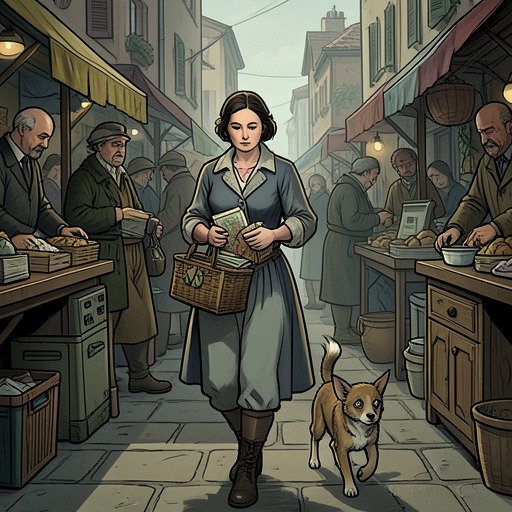
Rumpelstiltskin's spinning wheel
One Thousand and One NightsRumpelstiltskin's spinning wheel is a small, shabby object with an outsized role in Tad’s case: it produces material that Rumpelstiltskin presents to humans as gold, and it gives Tante Iezavel a way to identify him when he is disguised as a merchant. First encountered as an unexpected purchase, the wheel becomes a physical link between a suspicious marketplace, a familiar fairy-tale pattern, and the family conflict that explains the jinn’s dealings with humans.
Appearance and Acquisition
The wheel enters the investigation almost casually. While questioning a merchant about a generous woman’s habit of giving gifts, Tad interrupts to identify the small, circular, brown, rather shabby object the merchant has brought out: a spinning wheel. The merchant calls it practical but unexpected. Tad buys it for one silver piece, the last of the money in his true-love wooing fund apart from two coins, thinking that its homely appearance can be improved with a little cleaning. He has mistaken its plainness for ordinariness; the merchant immediately objects that it is no ordinary wheel.
The purchase is revealing in retrospect. Tad has acquired the object without knowing its owner or supernatural function, and his modest payment contrasts with the history and power attached to it. That mismatch makes the wheel a clue in its own right: it is not merely an unusual commodity but a conspicuous object that can be recognized by someone who knows the family to which it belongs.
What the Wheel Does
The wheel’s function emerges through the accusations made when its owner is unmasked. Paribanou identifies it as the wheel their father gave Rumpelstiltskin, and says that he uses it to spin material which he then claims is gold. Humans, she observes, cannot tell the difference. The deception depends not just on the wheel’s capacity to spin, but on the gap between what the material appears to be and what buyers can reliably judge it to be.
This explains why the object matters to the case’s inquiry into apparently genuine gold. Claire reasons that a merchant who sells finely crafted gold for roughly the equivalent value in gold coin has little obvious reason to do so, unless the goods are fake or stolen. Tad’s account that the necklace was hidden until the merchant had looked him over strengthens the suspicion that the seller knowingly handles dishonest goods. The wheel later supplies a more direct connection: Rumpelstiltskin has been using it to produce supposed gold, so the merchandise is part of a deliberate deception rather than an innocent trade. The distinction between real and counterfeit gold, initially a question of scientific testing and suspicious commerce, leads back to the wheel and its owner.
A Clue That Identifies Its Owner
The wheel becomes decisive when Tante Iezavel sees it in Claire’s hands. She says she found it among Claire’s scientific projects and knew at once who it belonged to, because there is only one like it. Her certainty turns an object Tad bought as an odd bargain into identifying evidence. Rumpelstiltskin, still appearing as a merchant, shrieks that it is his wheel and stamps his foot three times. His possessive reaction confirms the connection even before the disguise is removed.
Paribanou then explains the wheel’s place in the family history: their father gave it to Rumpelstiltskin, who has been using it to deceive humans with spun material presented as gold. At her command, Rumpelstiltskin’s merchant face changes into a wrinkled face with golden eyes, and his body shrinks to child size. The wheel does not itself transform him, but its recognition helps bring the false identity to an end. Its evidentiary force comes from its singularity and its known ownership, not simply from its appearance.
Family Conflict and Confinement
The wheel is more than a prop in the exposure of a disguise; it is also the means by which Rumpelstiltskin amuses himself and continues making bargains with humans. Paribanou threatens to ask their father to take it away forever if Rumpelstiltskin will not stop playing games. Her threat gives the wheel a place in the family’s effort to restrain him: it is a treasured possession that can be withheld as discipline, as well as an instrument that enables his tricks.
The confrontation also recalls the larger danger of his bargains. Della’s father explains that Rumpelstiltskin once demanded his firstborn child in exchange for a wish, and that the jinn later claimed Della by holding her mother’s necklace and father’s ring as proof. The father wonders what Rumpelstiltskin could want with the treasure when he can make his own. In light of Paribanou’s account of the wheel, the question becomes pointed: the ability to spin material he calls gold does not make every kind of wealth or inheritance interchangeable. The object belongs to the machinery of Rumpelstiltskin’s deception, but the wheel does not explain away his pursuit of Della.
Paribanou and Tante Iezavel treat the jinn’s conduct as a matter of choice and responsibility, not as an unavoidable consequence of his nature. Tante Iezavel says he should stop making deals with humans, while Paribanou reminds him that three hundred years is old enough to be held accountable for misplaced desires. She finally declares that he is going back into timeout and that this time the lamp will be placed where humans cannot go. The wheel is not explicitly taken from him in that outcome, but the family’s threat to remove it reveals what it represents: both a source of mischief and a point of leverage over its owner.
Story Function
The wheel connects several strands of the case without being reduced to a single clue. Tad first buys it without understanding its significance; Claire’s scientific work takes place around it and other objects in the library; and Tante Iezavel recognizes it, bringing the investigation from suspicious merchandise to Rumpelstiltskin’s identity. Its passage through these hands makes an apparently trivial purchase into material evidence that the characters can test, interpret, and finally use to expose a disguise.
Its fairy-tale associations are also made explicit within the investigation. Tad learns that a story about a miller’s daughter being tricked by a creature who spins straw into gold may concern the same jinn, though that version says nothing about a lamp. Later, at a crowd gathered around the disguised merchant, Tad hears him challenge a young man to guess his name in exchange for an item from the cart. The wheel therefore belongs to a recognizable pattern of spinning gold, deceptive bargains, and a name that can expose the trickster, while the book relocates that pattern inside an investigation involving a stolen lamp, a dangerous claim, and Rumpelstiltskin’s family. Its plain, shabby form is the counterpoint to the wealth it supposedly produces: the object looks modest, but the claims made through it have consequences far beyond its size.